Make Orson Welles Fiction Again Hat
| Orson Welles |
|---|
| Orson Welles in 1937 |
| Born |
| May 6, 1915 Kenosha, Wisconsin, U.S.A |
| Died |
| Oct 10, 1985 Los Angeles, California, U.s.a.A |
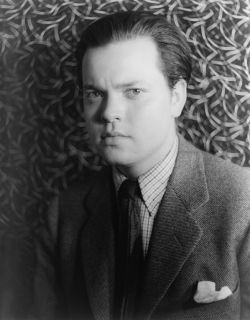
George Orson Welles (May 6, 1915 - October 10, 1985) was an American theater and film managing director, and theater, radio and picture show player. He gained international notoriety for his Oct 30, 1938 radio circulate of H.G. Wells' The War of the Worlds, which panicked millions of listeners into believing the broadcast was real. He also did notable and innovative theater and radio work in the 1930s and later on. However, he is all-time known for his 1941 film classic Denizen Kane, often chosen in polls of film critics as the greatest moving picture always made.
Contents
- 1 Biography
- 1.1 Youth and early on career (1915 to 1934)
- 1.2 Renown in theater and radio (1936 to 1939)
- 1.3 Welles in Hollywood (1939 to 1948)
- 1.4 Welles in Europe (1948 to 1956)
- one.5 Return to Hollywood (1956 to 1959)
- 1.6 Render to Europe (1959 to 1970)
- 1.7 Return to America and final years (1970 to 1985)
- 2 Unfinished projects
- 3 Wells' legacy
- 4 Selected filmography
- v References
- 6 External links
- 7 Credits
Biography
Youth and early career (1915 to 1934)
Welles was built-in in 1915, in Kenosha, Wisconsin, the second son of Richard Head Welles, a wealthy inventor, and Beatrice Ives, a concert pianist and suffragette. He was born on the day that Babe Ruth hit his beginning home run. At 18 months, Welles was declared a kid prodigy by Dr. Maurice Bernstein, a Chicago medico. His mother taught him Shakespeare, as well as the piano and violin; he learned magic from vaudevillians. When Welles was half dozen, his parents divorced and his female parent moved to Chicago with him, where they attended the opera, theater, and concerts. Beatrice Welles died of jaundice on May 10, 1924. Richard Welles died when the boy was fifteen, the summer later Welles'southward graduation from the Todd Schoolhouse for Boys in Woodstock, Illinois. Bernstein then became his guardian.
Welles performed and staged his commencement theatrical productions while attending the Todd Schoolhouse and was brought under the guidance of a teacher, later Todd's headmaster, Roger Colina.
Equally a child he was securely fascinated by conjuring, both stage and close upward. He traveled with a magic act on several occasions throughout his developed life. His involvement in the psychology employed past a magician surfaced in much of his moving-picture show-making. For example, in Citizen Kane, during the dialogue in the famous puzzle scene with his wife Susan Alexander, Kane walks back in the shot to stand up nigh the fireplace. He is unexpectedly dwarfed by the fireplace; a visual representation of his downward decline. The optical illusion obtained by Welles employs principles of "manipulation of perspective" used by magicians.
Welles fabricated his stage debut at the Gate Theatre of Dublin, Republic of ireland in 1931 at the age of sixteen, when he talked himself onto the stage and appeared in small supporting roles. By 1934 he was a radio thespian in New York City, working with actors who would later join him in forming the Mercury Theatre. In 1934, he married the actress and socialite Virginia Nicholson (they would accept one daughter, Christopher, who is a well-known illustrator of children's books known as Chris Welles Feder). His early motion-picture show, the eight-minute silent short motion picture, The Hearts of Age, likewise featured Nicholson. Welles too appeared in two Broadway productions with Katherine Cornell'southward company (where he came to the attention of producer John Houseman) and later accompanied them on a national bout.
Renown in theater and radio (1936 to 1939)
In 1936, the Federal Theater Projection (function of Roosevelt's Works Progress Administration), began putting unemployed theater performers and employees to work. Welles was hired by John Houseman and assigned to direct a project for Harlem's Negro Theater Unit. Wanting to requite his all-black cast a take a chance to play classics, he offered them Macbeth, gear up in Haiti at the court of King Henri Christophe, and with a setting of voodoo witch doctors; this has often been called the Voodoo Macbeth. The play was rapturously received and later toured the nation. It is considered a landmark of African-American theater. Welles was 20 and hailed as a prodigy.
Afterward the success of Macbeth, Welles put on Dr. Faustus and the satire Equus caballus Eats Hat. In 1937, he rehearsed Marc Blitzstein's pro-spousal relationship 'labor opera' The Cradle Will Rock, but due to Congressional worries nigh Communist propaganda in the Federal Theater, the testify's premiere at the Maxine Elliott Theater was cancelled, the theater locked and guarded by National Guardsmen. Welles and Houseman announced to ticket-holders that the show was existence taken to another theater, The Venice, about twenty blocks away. Cast, crew and audience walked the distance on foot. Ironically, since the unions forbade the actors and musicians to perform from the stage, The Cradle Will Stone began with Blitzstein introducing the prove and playing the piano accompaniment onstage, with the bandage performing their parts from the audience. The show was a tremendous hit.
Welles and Houseman and then formed their own company, the Mercury Theater, which included actors such as Agnes Moorehead, Joseph Cotten, Ray Collins, George Colouris, Frank Readick, Everett Sloane, Eustace Wyatt, and Erskine Sanford, all of whom would keep to work for Welles for years. The showtime Mercury Theater product was Shakespeare's Julius Caesar, ready in fascist Italy. Cinna the Poet died at the easily non of a mob simply a undercover constabulary force. According to Norman Lloyd, who played Cinna, "it stopped the evidence." The applause lasted more than than iii minutes. It was a dandy success and widely acclaimed.
At the same time, Welles became very agile on radio, first as an actor and soon equally a managing director and producer, for CBS and the Mutual Network. In the summer of 1938 CBS gave him (and the Mercury Theater) a weekly hour-long show to circulate radio plays based on archetype literary works, entitled The Mercury Theater on the Air, with original music by Bernard Herrmann, who would continue working with Welles on radio and in films for years.
During Welles' radio years, he often freelanced and would split his time between the Mercury Theater, CBS, Mutual, and NBC, among others. Due to this, Welles rarely apposite, instead reading ahead during other actors' lines, a practice used by some radio stars of the time. Many of his co-stars on The Shadow have remarked about this in various interviews. In that location are a number of apocryphal stories where Welles was reported to have turned to an actor during the mid-show commercial break and commented that this week'due south story was fascinating and he couldn't expect to "find out how it all ends." Welles admitted to preferring the cold-reading style in his on-air performances as he described the hectic nature of radio piece of work to Peter Bogdanovich in This Is Orson Welles:
Soon I was doing and then many [programs] that I didn't even rehearse. I'd come to a bad finish in some tearjerker on the seventh floor of CBS and rush upward to the ninth (they'd hold an elevator for me), where, only every bit the red light was going on, somebody'd hand me a script and whisper, "Chinese mandarin, seventy-five years old," and off I'd go over again… Not rehearsing… made information technology so much more than interesting. When I was thrown down the well or into some fiendish serpent pit, I never knew how I'd become out.
Due to Welles' often tight radio schedule, he was difficult pressed to find ways to get from job to job in busy New York Urban center traffic. In an interview conducted in his later years, Welles tells how he "discovered that in that location was no police in New York that y'all had to be sick to travel in an ambulance." Therefore, he took to hiring ambulances to have him, sirens blazing, through the crowded streets to go to various buildings.
On October 30, 1938, The Mercury Theater on the Air did H. G. Wells' The War of the Worlds. This brought Welles fame on an international level, as the program's realism created widespread panic among listeners who believed an actual Martian invasion was underway. Because of the notoriety of the production, Hollywood offers soon came Welles' mode.
Welles in Hollywood (1939 to 1948)
RKO Pictures president George Schaefer offered what is considered to have been the greatest contract ever offered: A two-picture show deal with total creative control, including script, cast, final cut, and coiffure. So Welles (and the entire Mercury Theater) moved to Hollywood.
For his beginning project for RKO, Welles settled briefly on an adaptation of Joseph Conrad's Heart of Darkness. He planned to pic the action with a subjective camera from the protagonist's betoken of view. Only when a budget was fatigued upwards, RKO'southward enthusiasm began to cool.
Realizing that he had to come up with something or else lose his film contract, Welles finally found a suitable project in an idea co-conceived with screenwriter Herman Mankiewicz. Initially chosen American, information technology would eventually become Welles' first feature motion picture, Denizen Kane (1941).
Mankiewicz' thought was based mainly on the life of William Randolph Hearst, whom Mankiewicz knew socially; he was friends with Hearst's mistress, Marion Davies. At Welles' urging, Mankiewicz wrote the screenplay, assisted past John Houseman, who wrote the opening narration in a pastiche of The March of Time newsreels. Welles then took the Mankiewicz draft, drastically condensed and rearranged information technology, and added at least three scenes of his ain. While the character of Charles Foster Kane is based at least partly on Hearst, there are also strong allusions to Welles himself, about noticeably in the treatment of Kane'due south childhood.
Welles hired the best technicians he could, including cinematographer Gregg Toland and film editor Robert Wise. For the cast, Welles primarily used actors from his Mercury Theatre. Later on, when asked how he had learned to brand moving picture, Wells replied, "By studying the Erstwhile Masters, by which I mean John Ford, John Ford, and John Ford." Welles reportedly viewed Ford's Stagecoach dozens of times every bit preparation for making Citizen Kane.
At that place was lilliputian business concern or controversy at the time that Welles completed production on the picture show. Withal, Mankiewicz gave a copy of the final shooting script to his friend Charles Lederer, the husband of Welles' ex-married woman Virginia Nicholson and nephew of Hearst'due south mistress, Marion Davies. In this way, Hearst found out about the existence of the movie and sent his gossip columnist, Louella Parsons, to a screening of the picture show. Parsons, realizing immediately that the flick was based on Hearst's life, reported back to him. Thus began the controversy over Citizen Kane.
Hearst's media empire boycotted the moving picture and exerted an enormous corporeality of pressure on the Hollywood film community, even threatening to expose all the studio bosses as Jewish. At one point, the heads of all the studios jointly offered RKO the cost of the film in exchange for the negative and all existing prints, for the express purpose of called-for it. RKO declined, and eventually the film was released. Yet, Hearst had successfully threatened every theater concatenation past stating that if they showed Citizen Kane he would non allow any advertising for any of their films in whatsoever of his papers, so aside from the theaters RKO endemic, in that location weren't many movie houses that actually played information technology. The film was critically well-received. It garnered nine Academy Accolade nominations, though it won only for Best Original Screenplay, shared by Mankiewicz and Welles. Only the pic fared poorly at the box-office, due to its lack of exposure, losing RKO almost of its $800,000 investment.
Welles was dating Billie Holiday around the time he was making Citizen Kane. According to Holiday'due south autobiography, Lady Sings the Dejection, she saw the film ix times before it ever played in a theater.
Welles' second picture for RKO was The Magnificent Ambersons, adjusted from the Pulitzer Prize-winning novel by Berth Tarkington, and on which RKO executives hoped to make back the money lost by Citizen Kane'southward relative commercial failure. Welles wrote the screen adaptation himself, purportedly while on King Vidor's yacht. Toland was not bachelor, so Stanley Cortez was named cinematographer. Cortez worked much more slowly than had Toland in realizing Welles' intentions, and the moving-picture show lagged behind schedule and over budget.
Simultaneously (and at RKO's request), Welles worked on an adaption of Eric Ambler'south spy thriller, Journey Into Fear, which he co-wrote with Joseph Cotten. In addition to interim in the flick, Welles was also a producer. Direction was credited solely to Norman Foster, but Welles later stated that they were in such a blitz that the director of each scene was whoever was closest to the camera.
During the product of Ambersons and Journey into Fright, Welles was asked by John Rockefeller and Jock Whitney to make a documentary film nearly Southward America on behalf of the regime's Adept Neighbor Policy. Expected to film the Carnival in Rio de Janeiro, Brazil, Welles was in a corking blitz to finish the editing on Ambersons and his acting scenes in Journey into Fear. He ended his CBS radio bear witness, put together a crude cut of Ambersons with film editor Robert Wise, and left the United States. He completed his last cut via phone phone call, telegram, and shortwave radio, and that version was previewed to a disastrous audience reaction. Since Welles' original contract granting him complete control was no longer in consequence, the studio took control of the motion picture, and proceeded to remove l minutes of Welles' footage, re-shooting sequences which had a bad audience reaction, rearranging the scene social club, and tacking on a happy ending. Schaefer was then replaced by new RKO president Charles Koerner, who released the shortened film on the bottom of a double-bill with the Lupe Velez one-act, Mexican Spitfire Sees a Ghost. Ambersons was an expensive flop for RKO, though Agnes Moorehead did receive a All-time Supporting Extra Oscar nomination for her performance.
Welles' Southward American documentary, titled It'due south All True, was budgeted at ane 1000000 dollars, with half of the budget to be paid by the U.Due south. Authorities upon completion of the film. Notwithstanding, RKO was appalled past the "rushes" they saw of interracial revelers at Funfair (non commercial fare for 1942). Welles was recreating the journey of the jangadeiros, four poor fisherman who had made a 1500 mile journey on their open raft to petition Brazilian president Vargas near their working conditions. The four had get national folk heroes. After their leader, Jacare, died during a filming mishap, Koerner closed the film and fired Welles and his entire company. Welles begged to be able to finish the film and was given a limited amount of black-and-white stock and a silent camera. He completed the sequence, but RKO refused to let him consummate the film. Some of the surviving footage was released in 1993, including a reconstruction of the Four Men on a Raft segment. RKO launched a publicity campaign against Welles, challenge he had gone down to Brazil without a screenplay and squandered a million dollars.
Unable to find piece of work every bit a film director after the twin disasters of The Magnificent Ambersons and It'due south All Truthful, Welles did discover work directing in 1942 on radio. CBS offered him two weekly series, Hi Americans, which was based on the research he'd washed in Brazil, and Ceiling Unlimited, sponsored by Lockheed/Vega and which was a wartime salute to advances in aviation. But within a few months Hi Americans was cancelled and Welles was replaced every bit host of Ceiling Unlimited by Joseph Cotten. Welles guest-starred on a great diversity of shows, notably invitee-hosting Jack Benny's evidence for a month in 1943.
Around this time, Welles married Rita Hayworth. They had a kid, Rebecca Welles, and divorced in 1948. Welles also found work as an actor in other directors' films. He too had a cameo in the 1944 wartime salute, Follow the Boys, in which he performed his Mercury Wonder Show magic act and sawed Marlene Dietrich in half.
In 1945 Welles starred in the tear-jerker Tomorrow Is Forever with Claudette Colbert. While his suitability as a film director remained in question, Welles' popularity as an player continued. Pabst Blue Ribbon gave Welles their radio series This Is My Best to direct, but after ane month he was fired for creative differences. He started writing a political cavalcade for the New York Post, again called Orson Welles Almanac. While requested by the paper to write about Hollywood, Welles wanted to explore political bug, and the column became a confused blending of both. The column failed in syndication and was presently dropped past the Post.
In 1946, International Pictures released Welles' pic The Stranger, starring Edward G. Robinson, Loretta Young and Welles. Sam Spiegel produced the film, which follows the hunt for a Nazi state of war criminal living under an alias in America. Seeking to avoid the expense and controversy of Welles' earlier films, Spiegel kept tight control of the project, and the result was insufficiently unimaginative work from Welles. Welles resolved non to have a career every bit a cog in a Hollywood studio and resumed looking for the creative control which had originally brought him to Hollywood.
In the summer of 1946, Welles directed a musical stage version of Around the World in Eighty Days, with a comedic and ironic rewriting of the Jules Verne novel by Welles, incidental music and songs past Cole Porter, and production by Mike Todd (who would later produce the successful picture version with David Niven). When Todd pulled out from the lavish and expensive production, Welles supported the finances himself. When he ran out of money at 1 betoken, he convinced Columbia president Harry Cohn to ship him enough to continue the prove, and in exchange Welles promised to write, produce, straight and star in a film for Cohn for no further fee. The stage prove would soon fail due to poor box-office, with Welles unable to merits the losses on his taxes. He wound up attributable the IRS several hundred 1000 dollars, and in a few years time Welles would seek revenue enhancement-shelter in Europe.
In 1946, he began two new radio series, The Mercury Summer Theatre for CBS and Orson Welles Commentaries for ABC. While Summer Theatre featured one-half-hr adaptations of some of the classic Mercury radio shows from the 1930s. Several original Mercury actors returned for the serial, too as Bernard Herrmann. It was only scheduled for the summertime months, and Welles invested his earnings into his failing stage play, Commentaries, a political soap-box, continuing the themes from his New York Post cavalcade. Once more Welles lacked a clear focus, until the NAACP brought to his attention the instance of Isaac Woodward. Welles devoted the rest of the run of the series to Woodward'due south cause and caused shockwaves across the nation. Soon Welles was existence hung in figure in the Southward and The Stranger was banned in several southern states. But ABC was unable to observe a sponsor for the radio show and soon canceled it, and Welles never had a regular radio evidence in America once again and would never straight another anywhere.
The film for Cohn wound up being The Lady from Shanghai, filmed in 1947 for Columbia Pictures. Intended to be a small-scale thriller, the budget skyrocketed after Cohn suggested that Welles' then-estranged second wife Rita Hayworth co-star. Cohn was enraged past Welles' rough-cut, in particular the disruptive plot and lack of close-ups, and ordered extensive editing and re-shoots. After heavy editing by the studio, approximately one hour of Welles' kickoff cut had been removed. The film was considered a disaster in America at the fourth dimension of release. Welles recalled people refusing to speak to him about information technology to save him embarrassment. Non long subsequently release, Welles and Hayworth finalized their divorce. Though the film was acclaimed in Europe, it was not embraced in the U.S. for several decades.
Unable to find work as a manager at whatever of the major studios, in 1948 Welles convinced Republic Pictures to let him straight a low-budget version of Macbeth, which featured paper-maché sets, cardboard crowns and a bandage of actors lip-synching to a prerecorded soundtrack. Republic did not care for the Scottish accents on the soundtrack and held up release for almost a twelvemonth. Welles left for Europe, while his co-producer and life-long supporter Richard Wilson reworked the soundtrack. The flick was decried every bit some other disaster. In the late 1970s, it was restored to Welles' original version.
Welles in Europe (1948 to 1956)
Welles left Hollywood for Europe in 1948, drawn by some acting offers and to look for producers who would allow him to direct. He also had the tax pecker to pay. Further, some people speculated that Welles was blacklisted or greylisted in Hollywood.
In Italia he starred as Cagliostro in the 1948 picture Black Magic. His co-star was Akim Tamiroff, who impressed Welles and so much that he appeared in four of Welles' own productions during the 1950s and 1960s.
The following year, Welles appeared as Harry Lime in The Third Human, written by Graham Greene, directed by Carol Reed, starring Mercury Theatre alumnus Joseph Cotten, and with a memorable zither score past Anton Karas. The film was an international smash hit, merely Welles unfortunately turned downwardly a percentage of the gross in exchange for a lump-sum advance.
Welles as well appeared as Cesare Borgia in the 1949 Italian moving-picture show Prince of Foxes, and as the Mongol warrior Bayan in the 1950 moving-picture show version of the novel The Black Rose. During this fourth dimension, Welles was channelling his money from interim jobs into a self-financed motion-picture show version of Shakespeare'southward play Othello.
From 1949 to 1951, Welles worked on Othello, filming on location in Europe and Morocco. Filming was suspended several times over the years equally Welles ran out of funds and left to notice other acting jobs. When it premiered at the Cannes Film Festival it won the Palme d'Or, but was not given a general release in the United states until 1955 and played but in New York and Los Angeles. The American release prints had a technically flawed soundtrack, and information technology was 1 of these flawed prints that was restored by Welles' daughter Beatrice Welles-Smith in 1992 for a wide re-release. The restoration included reconstructing the original musical score (which was inaudible) and adding ambience stereo audio effects (which weren't in the original picture show).
Tardily in 1953 Welles returned to America to star in a live CBS Omnibus television presentation of Shakespeare'southward play King Lear. While Welles received skilful notices, he was guarded by IRS agents, prohibited to leave his hotel room when not at the studio, prevented from making any purchases, and the entire sum (less expenses) he earned went to his tax neb. Welles returned to England later the broadcast.
In 1954, director George More O'Ferrall offered Welles the title office in the Lord Mountdrago segment of Iii Cases of Murder. Managing director Herbert Wilcox cast him as the antagonist in Trouble in Glen. And director John Huston bandage him equally Male parent Mapple in his film adaption of Herman Melville's Moby Dick, starring Gregory Peck.
Welles' adjacent turn equally director was Mr. Arkadin, the 1955 film produced by Louis Dolivet. It was filmed in France, Federal republic of germany, Spain, and Italia. Based on several episodes of the Harry Lime radio show, it stars Welles as a paranoid billionaire who hires a petty smuggler to delve into the secrets of his seedy past. Welles' absurd and obvious makeup has been the bailiwick of much derision, just it may have been the intent to testify a character who was in disguise and hiding his true identity. The film stars Robert Arden (who had worked on the Harry Lime series), Welles' third wife Paola Mori (whose vocalisation was completely redubbed by actress Billie Whitelaw), and a bevy of guest stars. Frustrated by Welles' slow progress in the editing room, producer Dolivet removed Welles from the project and finished the film without him. Somewhen 5 different versions of the film would be released, 2 in Castilian and three in English. The version which Dolivet completed was retitled Confidential Report (this was the version furthest from Welles' original intentions.) In 2005, Stefan Droessler of the Munich Moving picture Museum oversaw a reconstruction of what might take been Welles' original intention. Information technology was released by the Criterion Company on DVD and is considered by managing director and Welles scholar Peter Bogdanovich to be the best version available.
Also in 1955, Welles directed ii television series for the BBC. The kickoff was Orson Welles' Sketchbook, a serial of six xv-minute shows featuring Welles cartoon in a sketchbook to illustrate his reminiscences for the photographic camera; the second was Effectually the Globe with Orson Welles, a series of six travelogues set up in different locations around Europe (such as Venice, the Basque country between France and Kingdom of spain, and England). Welles served every bit host and interviewer, his commentary including documentary facts and his own personal observations.
In 1956 Welles completed Portrait of Gina (posthumously aired on German tv under the title Viva Italia), a 30 minute personal essay on Gina Lollobrigida and the general subject of Italian sex symbols. Dissatisfied with the results, he left the only print behind at the Hotel Ritz in Paris, where the film cans would remain in a lost and found locker for several decades (ultimately to be rediscovered after his death).
Return to Hollywood (1956 to 1959)
In 1956, Welles returned to Hollywood, guesting on radio shows (notably as narrator of Tomorrow, a nuclear holocaust drama produced by the Federal Ceremonious Defense Administration) and television shows (including I Love Lucy) and began filming a projected pilot for Desilu (owned by his former protegee Lucille Ball and her husband Desi Arnaz, who had recently purchased the defunct RKO studios). The motion picture was The Fountain of Youth, based on a story past John Collier. Deemed united nations-commercial and unviable as a airplane pilot, the moving-picture show sat on the shelf for ii years. When it was aired in 1958, it won the Peabody Award for excellence.
Welles' next characteristic film role was in Man in the Shadow for Universal Pictures in 1957, starring Jeff Chandler.
Welles stayed on at Universal to costar with Charlton Heston in the 1958 picture show of Whit Masterson's novel Bluecoat of Evil (which Welles famously claimed never to accept read). Originally simply hired every bit an player, he was promoted to director by Universal Studios at the suggestion (and insistence) of Charlton Heston. Reuniting many actors and technicians with whom he'd worked in Hollywood in the 1940s—including cameraman Russell Metty (The Stranger), make-upwards artist Maurice Siederman (Denizen Kane), and actors Joseph Cotten, Marlene Dietrich, and Akim Tamiroff—the filming proceeded smoothly, with Welles finishing on schedule and on budget, and the studio bosses praising the daily rushes. However, once in the editing room, the studio wrested Bear on of Evil from Welles' hands, re-edited it, re-shot some scenes, and shot new exposition scenes to analyze the plot. When Welles viewed the studio's preview version, he wrote a 58-folio memo outlining his suggestions and objections. The studio followed a few of the ideas, then cutting another 30 minutes from the film and released it. Even in this state, the picture show was widely praised beyond Europe, awarded the top prize at the Brussels World's Fair. In 1978, the long preview version of the film was rediscovered and released, and in 1998, editor Walter Murch and producer Rick Schmidlin consulted the original memo, and using a workprint version they attempted to restore the flick as close as possible to the memo. Welles stated in that memo that the film was no longer his version; it was the studio's, merely as such, he was yet prepared to help them with it.
While Universal reworked Evil, Welles began filming his adaptation of Miguel Cervantes' novel Don Quixote in Mexico, starring Mischa Auer as Quixote and Akim Tamiroff as Sancho Panza. While filming would go along in fits and starts for several years, Welles would never consummate the project.
Welles continued acting, notably in The Long, Hot Summer (1958) and Compulsion (1959), but soon returned to Europe to go on his pattern of self-producing low budget films over which he would have artistic control and final cut.
Render to Europe (1959 to 1970)
Welles returned to Europe and resumed acting jobs. He connected shooting Don Quixote in Spain, simply replaced Mischa Auer with Francisco Reiguera.
In Italia, in 1959, Welles directed his own scenes as Male monarch Saul in Richard Pottier'due south film David and Goliath. In Hong Kong he costarred with Curt Jurgens in Lewis Gilbert's film Ferry to Hong Kong.
In 1960 in Paris he costarred in Richard Fleischer's film Crack in the Mirror. In Yugoslavia he starred in Richard Thorpe'southward flick The Tartars. He also staged a play at the Gate Theatre in Dublin which compressed five of Shakespeare's history plays in order to focus on the story of Falstaff. Keith Baxter played Prince Hal and Welles chosen the adaption Chimes at Midnight.
Past this fourth dimension he had completed filming on Quixote. Though he would continue toying with the editing well into the 1970s, he never completed the pic. On the scenes he did consummate, Welles voiced all the actors and provided the narration. In 1992 a version of the flick was completed past managing director Jess Franco, though not all the footage Welles shot was available to him. What was available had decayed badly. While the Welles footage was greeted with interest, the post-product past Franco was met with harsh criticism.
In 1962, Welles directed his adaption of The Trial, based on the novel by Franz Kafka. The cast included Anthony Perkins as Josef K, Jeanne Moreau, Romy Schneider, Paola Mori, and Akim Tamiroff. While filming exteriors in Zagreb, Welles was informed that the producers had run out of money, meaning that there could be no set structure. No stranger to shooting on establish locations, Welles presently filmed the interiors in the Gare d'Orsay, at that time an abased railway station in Paris. Welles thought the location possessed a "Jules Verne modernism" and a melancholy sense of "waiting," both suitable for Kafka. The film failed at the box-office. Peter Bogdanovich would subsequently observe that Welles found the movie riotously funny. During the filming, Welles met Oja Kodar, who would later become his muse, star and partner for xx years until the end of his life.
Welles connected taking what work he could find acting, narrating or hosting other people's work, and began filming Chimes at Midnight, which was completed in 1966. Filmed in Espana, it was a condensation of five Shakespeare plays, telling the story of Falstaff and his relationship with Prince Hal.
In 1966, Welles directed a moving-picture show for French television, an adaption of The Immortal Story, by Isak Dinesen. Released in 1968, it stars Jeanne Moreau, Roger Coggio and Norman Eshley. The film had a successful run in French theaters. At this fourth dimension Welles met Kodar again, and gave her a letter he had written to her and had been keeping for four years; they would not be parted again. They immediately began a collaboration both personal and professional person, which would go on for the rest of his life. The first of these was an adaptation of Isak Dinesen's "The Heroine," meant to exist a companion piece to "The Immortal Story" and starring Kodar; unfortunately, the funding disappeared after one solar day's shooting.
In 1967 Welles began directing The Deep, based on the novel Dead Calm by Charles Williams and filmed off the shore of Yugoslavia. The bandage included Jeanne Moreau, Laurence Harvey and Kodar. Personally financed by Welles and Kodar, they could not obtain the funds to complete the projection, and it was abandoned a few years later after the death of Laurence Harvey. The surviving footage was eventually restored past the Filmmuseum München.
In 1968 Welles began filming a Television special for CBS under the title Orson'south Bag, combining travelogue, comedy skits and a condensation of Shakespeare's play The Merchant of Venice with Welles every bit Shylock. Funding for the show sent by CBS to Welles in Switzerland was seized by the IRS, reputedly due to the acrimony of Richard Nixon over a tape Welles had not written just had narrated (the political satire The Begatting of the President.) Without funding, the show was not completed. The surviving portions were eventually restored by the Filmmuseum München.
In 1969, Welles authorized the use of his proper name for a pic theater in Cambridge, Massachusetts, and the Orson Welles Cinema remained in operation until 1986 (with Welles making a personal appearance in that location in 1977).
Fatigued by the numerous offers he received to work in television and films, and upset past a tabloid scandal reporting his affair with Kodar, Welles abandoned the editing of Don Quixote and moved back to America in 1970.
Return to America and final years (1970 to 1985)
Welles returned to Hollywood, where he continued to self-finance his ain film and goggle box projects. While offers to act, characterize and host connected, Welles likewise found himself in great demand on talk shows, and made frequent appearances for Dick Cavett, Johnny Carson, and Dean Martin. Welles' primary focus in this period was filming The Other Side of the Current of air, a project that took 6 years to movie but has remained unfinished and unreleased.
In 1971, Welles directed a short adaption of Moby Dick, a one-homo operation on a bare stage, reminiscent of his phase production Moby Dick—Rehearsed from the 1950s. Never completed, it was eventually restored by the Filmmuseum München.
In 1971, the Academy of Movement Picture Arts and Sciences gave him an honorary award "For tiptop artistry and versatility in the cosmos of motion pictures." Welles pretended to be out of boondocks and sent John Huston to claim the laurels. Huston criticized the Academy for awarding Welles while they refused to give him any work.
In 1973, Welles completed F for Imitation, a personal essay pic almost art forger Elmyr d'Hory and his biographer Clifford Irving. Based on an existing documentary by Francois Reichenbach, information technology included new material with Oja Kodar, Joseph Cotten, Paul Stewart, and William Alland.
Working once more for British producer Harry Alan Towers, Welles played Long John Argent in managing director John Hough'southward 1973 adaptation of Robert Louis Stevenson's novel Treasure Island, which had been the second story circulate by The Mercury Theatre on the Air in 1938. Welles also contributed to the script, his writing credit was attributed to the pseudonym "O. West. Jeeves," and may take co-directed his scenes, equally the film displays some Wellesian cinematic touches.
In 1975, the American Film Institute presented Welles with their third Lifetime Achievement Award (the first ii going to director John Ford and actor James Cagney). At the ceremony, Welles screened two scenes from the nearly finished The Other Side of the Current of air. By 1976. Welles had almost completed the flick. Financed past Iranian backers, ownership of the motion-picture show fell into a legal quagmire later on the Shah of Iran was deposed. Written by Welles, the story told of a destructive old motion-picture show manager looking for funds to complete his final film. It starred John Huston and the cast included Peter Bogdanovich, Susan Strasberg, Norman Foster, Edmond O'Brien, Cameron Mitchell, and Dennis Hopper. Equally of 2006, all legal challenges apropos buying of the film have been settled and terminate money for completing the flick is existence sought, in part from the Showtime cablevision network.
In 1979 Welles completed his documentary Filming Othello, which featured Michael MacLiammoir and Hilton Edwards. Made for West German goggle box, it was also released in theaters. That same year, Welles completed his cocky-produced pilot for The Orson Welles Evidence television set series, featuring interviews with Burt Reynolds, Jim Henson, and Frank Oz and guest-starring The Muppets and Angie Dickinson. Unable to find network interest, the pilot was never broadcast.
Beginning in the belatedly 1970s, Welles participated in a series of famous television commercial advertisements, interim equally the on-camera spokesman for the Paul Masson vino company. The sign-off phrase of the commercials—"Nosotros will sell no wine before its time"—became a national catchphrase.
In 1980, the BBC broadcast The Orson Welles Story for the Arena series. Interviewed past Leslie Megahey, Welles examined his by in great detail, and several people from his professional by were interviewed besides.
During the 1980s, Welles worked on such moving picture projects every bit The Dreamers, based on 2 stories by Isak Dinesen and starring Oja Kodar, and The Orson Welles Magic Prove, which reused material from his failed TV pilot. Some other project he worked on was Filming The Trial, the second in a proposed series of documentaries examining his feature films. While much was shot for these projects, none of them were completed. All of them were eventually restored by the Filmmuseum München.
Welles had iii daughters to iii unlike mothers: children's author Chris Welles Feder, born 1937 (to mother Virginia Nicholson); Rebecca Welles Manning, 1944-2004 (to mother Rita Hayworth); and Beatrice Welles, born in November 1955 (to mother Paola Mori).
Welles in his later years was unable to become funding for his many moving picture-scripts, simply came close with The Big Brass Ring and The Cradle Will Rock: Arnon Milchan had agreed to produce The Big Contumely Ring if any 1 of half dozen actors—Warren Beatty, Clint Eastwood, Paul Newman, Jack Nicholson, Robert Redford, or Burt Reynolds—would sign on to star. All six declined for various reasons. Independent funding for The Cradle Will Rock had been obtained and actors had signed on, including Rupert Everett to play the young Orson Welles, location filming was to be done in New York City with studio work in Italy. While pre-product went without a problem, three weeks before filming was to begin the money brutal through. Allegedly Welles approached Steven Spielberg to ask for assistance in rescuing the flick, simply Spielberg declined. The scripts to both films were published posthumously. Later a studio auction, he complained that Steven Spielberg spent $50,000 for a Rosebud sled used in Citizen Kane, but would not give him a dime to make a motion-picture show. Welles retaliated by publicly announcing the sled to exist a fake, the original having been burned in the film, but he later recanted the claim.
Welles performed narration for two songs by the heavy metal band Manowar, a favorite of his niece. The narration on the vocal "Defender" (from Fighting the World), released two years subsequently his death, is among Welles' concluding performances. He also narrated "Drippy the Runaway Raindrop" by Sidney, Mary and Alexandra Sheldon which continues to be a popular English language educational series in Nihon.
His last filmed advent was on the television show Moonlighting. He recorded an introduction to an episode entitled "The Dream Sequence Always Rings Twice," which was partially filmed in black and white. The episode aired v days after his expiry and was dedicated to his memory. His last role was the voice of the planet eating robot Unicron in Transformers: The Movie, released almost a year after his death on August viii, 1986.
Welles died of a middle attack at his abode in Hollywood, California at historic period lxx on October 10, 1985; the same day as his Battle of Neretva co-star Yul Brynner. Wells had various projects underway, including a planned film adaption of King Lear, The Orson Welles Magic Testify, and The Dreamers. His final interview had been recorded the day before, on The Merv Griffin Show and with his biographer Barbara Leaming. The last film roles before his death included voice work in the animated films Transformers: The Movie (every bit the villainous god Unicron) and The Enchanted Journey and on-screen in Henry Jaglom's pic Someone to Honey, released in 1987.
According to Welles' associates, the cinematographer Gary Graver, and his companion Oja Kodar, Welles did not wish to exist cremated, just his wife Paola and daughter Beatrice had the cremation performed, and his ashes were eventually placed in a dry out well at a friend'due south estate in Ronda, Spain. According to some reports, some of his ashes take been scattered in the town'due south famous Plaza de Toros, the oldest bullfighting ring in Kingdom of spain still in utilise.
Unfinished projects
Welles' exile from Hollywood and reliance on contained production meant that many of his afterward projects were filmed piecemeal or were not completed. In the mid-1950s, Welles began work on the Cervantes' masterpiece Don Quixote, initially a commission from CBS television receiver. Welles expanded the motion picture to feature length, developing the screenplay to take Quixote and Sancho Panza into the modern age. The project was finally abandoned with the death of Francisco Reiguera, the histrion playing Quixote, in 1969. An incomplete version of the flick was released in 1992.
In 1970, Welles began shooting The Other Side of the Air current, well-nigh the effort of a film director (played by John Huston) to complete his last Hollywood picture, and is largely set at a lavish party. Although in 1972 the motion picture was reported past Welles as beingness "96 percent complete," the negative remained in a Paris vault until 2004, when Peter Bogdanovich (who also acted in the moving-picture show) announced his intention to consummate the production. Footage is included in the documentary Working with Orson Welles (1993)
Other unfinished projects include The Deep, an accommodation of Charles Williams's Expressionless Calm—abandoned in 1970 one scene short of completion due to the expiry of star Laurence Harvey—and The Big Brass Ring, the script of which was adapted and filmed past George Hickenlooper in 1999.
Wells' legacy
Each decade since 1952, the magazine, Sight and Sound, of the British Film plant has conducted a poll of hundreds of film critics worldwide as to what they regard as the best movies ever made. For the past several decades—the nearly recent poll was in 2002—Denizen Kane has topped that listing. Although it is non universally admired, more people have given that picture such an accolade than any other. Also, as i critic observed, there are a large number of people who decided to become filmmakers and directors as a result of viewing that movie. So the influence and legacy of Wells to filmmaking and directing is immense. For i important example, when asked to describe Welles' influence, Jean-Luc Godard remarked: "Everyone volition always owe him everything" (Ciment, 42).
No ane in the history of world cinema has known more about how to brand a nifty movie than Orson Welles. His genius—in theater, and so in picture show—is 2d to none. He was a get-go-rate actor, and his deeply resonant speaking vocalization was unmistakable and used to its total in radio, theater, and picture show. In theater he was known peculiarly for his innovative lighting and use of sound. In motion picture his prototype construction and blocking of scenes, besides as his utilize of sound and music and his florid fashion, were powerful, fresh, and instructive. More than 1 filmmaker has idea that he discovered something new about moving-picture show, only to see Citizen Kane again and discover that it is already there in that movie.
But there is also the fact that, after that initial success, Wells was responsible for a very big number of unfinished, botched, or merely partly realized films, and that he spent much of his life working as an thespian or hired hand on 2nd-rate projects of others, although his part every bit Harry Lime in The Third Man, directed by Carol Reed, is one of the swell performances in globe movie theatre. Concerning his career, Welles remarked, "I started out at the acme and worked down from there."
The lack of successfully completed projects after Citizen Kane can be blamed partly on boycotts and unwillingness of Hollywood moguls to trust and fund him, especially subsequently the controversy near and lack of commercial success of Kane. But a great deal of the blame must likewise go to Welles. He was unreliable. He usually did non see things through to the end, leaving them in the hands of others while he rushed off to something else. In addition, although everyone recognized his genius, he was often demanding, expensive to support, and otherwise difficult to piece of work with. He seems non to have wanted to terminate and release things because he wanted to continue redoing them, tinkering with them, editing them, because once something was released, it was out of his easily and he could no longer alter it.
Welles has said that The Trial and Chimes at Midnight were his most rewarding achievements, Impact of Evil the most fun to make and The Stranger his least significant motion-picture show.
Some people have asked why he became then fat. The answer seems to be that he had enormous appetites and indulged them. His regular dinner was two steaks and a pint of scotch. During his early on years, specially while filming Citizen Kane, Welles' entire dinner bill of fare also included a full pineapple, triple pistachio ice cream, and a full bottle of scotch.
Welles was known to have some close friends and supporters in the moving-picture show industry; it was he who suggested to Peter Bogdanovich that he motion-picture show The Last Picture Evidence in black & white. He had a shut association and friendship in his later years with Henry Jaglom. Welles was Francis Ford Coppola'south first choice to play Colonel Kurtz in Apocalypse Now (1979), based on Joseph Conrad's novel Centre of Darkness which Welles was planning to accommodate before he wrote Citizen Kane. Welles was originally considered for the part of Darth Vader in Star Wars, simply George Lucas idea Wells would exist likewise easily recognized. He voiced a trailer for The Incredible Shrinking Man in 1957 as well as the original trailer for Star Wars in 1977.
Especially because of his resonant voice and rococco style, Wells has been parodied and used by others, among them comedian Bill Martin in his monologue, An Evening with Sir William Martin. The Brain, the evil genius lab mouse in the drawing series Pinky and the Brain, was loosely based on Orson Welles. The Brain even parodies Welles' The War of the Worlds broadcast and his infamous radio commercial statement. Vox creative person Maurice LaMarche provided the voice of The Brain, and would later portray a bloated Orson Welles at the depression point of his television career in The Critic. And the lyrics of the song "The Union Forever," on the White Stripes 2001 album "White Blood Cells," are almost entirely composed of dialogue from "Citizen Kane."
Selected filmography
Directed by Welles
- Hearts of Age (1934)—Welles' first picture show, a silent i-reeler fabricated at age 18.
- Too Much Johnson (1938)
- Citizen Kane (1941)—won Oscar for Best Writing (Original Screenplay); nominated for Best Actor, Best Movie and Best Managing director.
- The Magnificent Ambersons (1942) - nominated for Oscar for All-time Picture; shortened and recut confronting Welles' wishes, footage forever lost
- The Stranger (1946)
- The Lady from Shanghai (1947)—shortened and recut against Welles' wishes, footage forever lost
- Macbeth (1948)—shortened and recut against Welles' wishes, recently restored to original vision
- Othello (1952)—won the Palme d'Or, 1952 Cannes Film Festival
- Mr. Arkadin (also known as Confidential Written report) (1955)—shortened and recut against Welles' wishes, Criterion'southward restoration released in Apr 2006.
- Touch of Evil (1958)—won the superlative-prize at the Brussels Globe'southward Fair; shortened and recut against Welles' wishes, recently restored to original vision
- The Trial (1962)
- Chimes at Midnight (1965)
- The Immortal Story (1968)
- The Deep (1970)—unfinished
- The Other Side of the Air current (1970-76)—currently unreleased, restoration in progress
- F for Fake (too known as Vérités et mensonges) (1974)
Other notable films
- Swiss Family Robinson (1940)—narration
- It's All Truthful (1942)
- Journey Into Fear (1943)—actor, rumored to be co-manager with Norman Foster. Welles denied he directed it.
- Jane Eyre (1944)—thespian (Rochester)
- Duel in the Sun (1946)—narration
- Monsieur Verdoux (1947)—story idea
- The Third Human (1949)—thespian, dialogue
- Moby Dick (1956)—cameo office every bit thespian
- Man in the Shadow (1957)—thespian
- The Long Hot Summer (1958) Volition Varner
- Coercion (1959)—role player
- A Man for All Seasons (1966)—histrion
- I'll Never Forget What's'isname (1967)—actor
- Casino Royale (1967)—as Bond villain Le Chiffre ("Nothing" or "The Zero")
- Don Quixote (1969, version released 1992)—author, director, actor
- The Battle of Neretva (1969)—every bit Chetnik senator
- Start the Revolution Without Me (1970)—narration, cameo part
- Grab-22 (1970)—thespian
- Waterloo (1970)—actor
- Flame of Persia (1972)—Documentary narration
- Treasure Island (1972)
- The Muppet Moving picture (1979)—cameo
- History of the World, Function One (1981)—narration
- The Dreamers (1980-82, unfinished)—actor, author, director
- Transformers: The Movie (1986)—voice actor
References
ISBN links support NWE through referral fees
- Anderegg, Michael. Orson Welles, Shakespeare and Pop Culture. New York: Columbia University Press, 1999. ISBN 0231112289.
- Bazin, André. Orson Welles: A Disquisitional View. Los Angeles: Acrobat Books, 1991. ISBN 0918226287.
- Berg, Chuck, and Tom Erskine (ed.). The Encyclopedia of Orson Welles. New York: Facts On File, 2003. ISBN 0816043906.
- Brady, Frank. Denizen Welles: A Biography of Orson Welles. New York: Charles Scribner's Sons, 1989. ISBN 0684189828
- Unconversant, Simon. Orson Welles: The Road to Xanadu. New York: Viking, 1996. ISBN 0670867225.
- Carringer, Robert L. The Making of Citizen Kane. Berkeley: Academy of California Press, 1996. ISBN 0520205677.
- Carringer, Robert L. The Magnificent Ambersons: A Reconstruction. Berkeley: Academy of California Press, 1993. ISBN 0520078578.
- Comito, Terry (ed.). Touch of Evil: Orson Welles, Manager. New Brunswick, NJ: Rutgers University Press, 1985. ISBN 0813510961.
- Conrad, Peter. Orson Welles: The Stories of His Life. London: Faber and Faber, 2003. ISBN 0571209785.
- Cowie, Peter. The Movie house of Orson Welles. New York: Da Capo Press, 1983. ISBN 0306802015.
- Drazin, Charles. In Search of the Third Homo. New York: Limelight Editions, 2000. ISBN 0879102942.
- Estrin, Mark. Orson Welles Interviews. Jackson: University Press of Mississippi, 2002. ISBN 157806208X.
- France, Richard (ed.). Orson Welles on Shakespeare: The W.P.A. and Mercury Theatre Playscripts. New York: Greenwood Printing, 1990. ISBN 0313273340.
- French republic, Richard. The Theatre of Orson Welles. Lewisburg, PA: Bucknell University Press, 1977. ISBN 0838719724.
- Garis, Robert. The Films of Orson Welles. Cambridge: Cambridge University Printing, 2004. ISBN 0521640148.
- Greene, Graham. The Third Homo. New York: Penguin, 1981. ISBN 0140032789.
- Heyer, Paul. The Medium and the Magician: Orson Welles, The Radio Years. Lanham, Doctor: Rowman and Littlefield, 2005. ISBN 9780742537965.
- Heylin, Clinton. Despite the System: Orson Welles Versus the Hollywood Studios. Chicago: Chicago Review Press, 2005. ISBN 1556525478.
- Higham, Charles. The Films of Orson Welles. Berkeley: Academy of California Press, 1970. ISBN 0520015673.
- Higham, Charles. Orson Welles: The Rise and Autumn of an American Genius. New York: St. Martin'south Press, 1985. ISBN 0312589298.
- Leaming, Barbara. Orson Welles. New York: Viking, 1985. ISBN 0670528951.
- Lyons, Bridget Gellert (ed.). Chimes at Midnight. New Brunswick, NJ: Rutgers, 1988. ISBN 0813513391.
- Mac Liammóir, Micháel. Put Money in Thy Purse: The Diary of the Pic of Othello. London: Methuen, 1952.
- McBride, Joseph. Orson Welles. New York: Da Capo Printing, 1996. ISBN 0306806746.
- Naremore, James. The Magic World of Orson Welles. Dallas: Southern Methodist University Press, 1989. ISBN 087074299X.
- Naremore, James (ed.). Orson Welles's Denizen Kane: A Casebook. New York: Oxford University Press, 2004. ISBN 0195158911.
- Noble, Peter. The Fabulous Orson Welles. London: Hutchinson and Co., 1956.
- Rosenbaum, Jonathan. "The Battle Over Orson Welles." In Essential Movie theatre: On the Necessity of Film Canons. Baltimore: Johns Hopkins University Printing, 2004. ISBN 0801878403.
- Rosenbaum, Jonathan. "Orson Welles as Ideological Claiming." In Movie Wars: How Hollywood and the Media Conspire to Limit What Films We Can See. Chicago: A Capella Books, 2000. ISBN 1556524064.
- Taylor, John Russell. Orson Welles: A Celebration. London: Pavilion, 1986. ISBN 1851450025.
- Welles, Orson, and Bogdanovich, Peter. This is Orson Welles. New York, NY: HarperCollins, 1992. ISBN 0060166169.
External links
All links retrieved January 5, 2019.
- Orson Welles at the Internet Picture Database
- Orson Welles at the TCM Movie Database
- Orson Welles at the Internet Broadway Database
- Wellesnet The Orson Welles Web Resource
- The Orson Welles collection at the Lilly Library
- (French) Orson Welles biography
Credits
New World Encyclopedia writers and editors rewrote and completed the Wikipedia commodity in accordance with New World Encyclopedia standards. This article abides by terms of the Creative Commons CC-by-sa iii.0 License (CC-by-sa), which may be used and disseminated with proper attribution. Credit is due under the terms of this license that can reference both the New World Encyclopedia contributors and the selfless volunteer contributors of the Wikimedia Foundation. To cite this article click here for a list of acceptable citing formats.The history of earlier contributions by wikipedians is accessible to researchers here:
- Orson_Welles history
The history of this article since it was imported to New World Encyclopedia:
- History of "Orson Welles"
Note: Some restrictions may apply to use of individual images which are separately licensed.
barnesexagagaidid.blogspot.com
Source: https://www.newworldencyclopedia.org/entry/Orson_Welles
0 Response to "Make Orson Welles Fiction Again Hat"
Post a Comment